
After the Hunt: A Review
A scene in Luca Guadagnino’s newest feature After the Hunt rehearses a familiar confrontation. Yale professor Hank (Andrew Garfield) has been accused of sexually assaulting a student, Maggie (Ayo Edebiri). To his colleague Alma (Julia Roberts), with whom he shares a romantic past, he deploys every well-worn defense: Maggie tried to seduce him; she plagiarized, so she is now lying to discredit him. He even admits it sounds like a cliché.
At this point, a quarter of the way in, I began to worry that Guadagnino’s latest had inadvertently articulated its own vice—cliché. But what unfolds is not just any tired “he said/she said” flick, but a handsomely provocative campus psychodrama that constantly destabilizes our sympathies, at once arresting and uneasy.
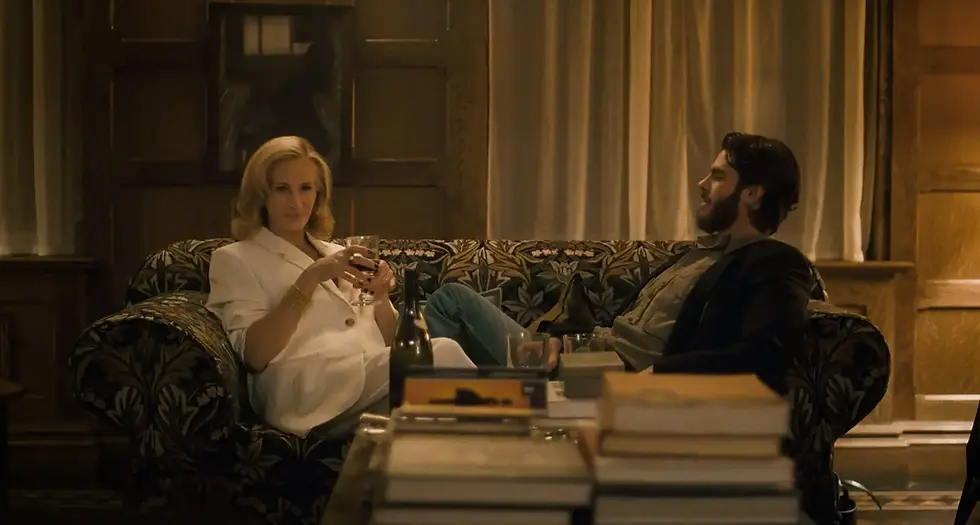
Rather than sorting the characters neatly into victim and perpetrator, After the Hunt populates its world with people who are complex, unreliable, and unlikeable in their own ways. Hank is charming but self-absorbed, veering into menace. Maggie is entitled and slippery, never consistent in her motives; her sense of entitlement grants her license to manipulate the truth. Even Alma’s husband Frederik (Michael Stuhlbarg), who is ardently adoring of his wife, is mired in passive-aggression and self-pity.
But the movie’s true fascination is Alma, a near-tenured philosophy professor whose authority is never secure. As Frederik points out, Alma likes to surround herself with acolytes, cultivating a devotion in Maggie that borders on unhealthy. She is magnetic but testy—delusional, but oddly perceptive to the “rotten” in her past, which culminates in a quietly devastating reveal. Through Alma, Guadagnino stages the film’s central generational clash: her vision of female progress is rooted in sacrifice and endurance, while Maggie’s sense of empowerment is self-assured, and she is quick to assign blame to systemic failures. The gap is stark: one generation numbs its pain through silence and self-destruction; the other weaponizes that pain, making it visible and performative. Over the course of the film, their relationship grows gradually more poisonous, depicting the way women are forced to compete with one another for recognition, acclaim, and survival in male-dominated spaces. Roberts, in particular, well conveys the struggle to mask one's emotions in a profession that demands constant composure.

The fact that the film’s thematic concerns resist clarity as much as the characters do is likely to frustrate some viewers. After the Hunt refuses the satisfactions of genre filmmaking: it is not a legal drama building toward a climactic trial, nor a psychological thriller indulging in violence or eroticism. Instead, Guadagnino dwells in ambivalence. We never see the incident that inculpates Hank, and the film refuses to adjudicate truth and deliver a verdict.
Guadagnino’s sense of irony runs through the film’s texture. The alphabetical title cards recall Woody Allen. Chloe Sevigny’s therapist delights at hearing The Smiths in a college bar—an ironic gesture, given Morrissey’s controversial legacy. Explicit commentary is not offered on these invocations; rather, they are designed to serve as surface provocations, cultivating a distance that makes us aware of the characters’ own efforts to manipulate our response. This same ironic distance is inscribed into the film’s visual language, particularly in Guadagnino’s use of close-ups. He often cuts to the characters’ hands, inviting us to question their reliability through a reminder that while words can perform identities, the body betrays truths. At times, a character’s face fills the entire frame, and they look almost directly into the camera lens, as if pleading their innocence.

Guadagnino’s tongue-in-cheek humor sharpens an ambivalence that feels entirely deliberate. We are not led to believe that any of the characters are completely innocent; the movie implies that each character bears some guilt, and that our sympathies must necessarily see-saw as we witness their attempts to reckon with that complicity. Indeed, Guadagnino wagers that truth always lies in the in-between; our task is to hold multiple truths at once. This ambiguity reflects one of Guadagnino’s sharpest critiques: that our culture resists uncomfortable conversations in its preoccupation with absolute responses—what a Yale dean dryly calls “the business of optics, not substance.” The film refuses that flattening. It insists in its disreputable tagline that “not everything is supposed to make you comfortable,” and true to form, it forces us to sit with unease rather than escape it.
Perhaps this is why Guadagnino chose a philosophy department as his setting. Philosophy, as we have learned through our Contemporary Civilization classes, is all about the search for meaning—but that search never yields anything stable. The “hunt” of the title becomes a metaphor for this futility: the hunt for tenure becomes the hunt for blame, or for recognition. The same holds for the ebb and flow of culturally dominant ethical fashions, which Guadagnino suggests is just another kind of hunt, one in which morally palatable explanations create an illusion of truth. Alma and Maggie embody this bind, each trapped within the moral vocabulary of her own era, unable to imagine a continuity between their worlds and the roles they occupy within them. Whether or not they get what they want is almost immaterial; what persists is the restless movement toward it.
Sophie Elliott is a sophomore in CC studying Applied Math. She is passionate about film, literature, and classical music.