
Niche Vampire Films to Watch If You Hate Jonathan Harker
If you’ve seen 1931’s Dracula, the basic formula of all subsequent adaptations will feel pretty familiar: Jonathan Harker, or some other pasty wimp with a similar name, helps his friendly Eastern European host buy an English home—after a bit of torture, his host sails off to England to steal his fiancée, and it’s finally up to Jonathan and scientist Van Helsing to defeat the vampire. This structure and the unnecessary foregrounding of its white-bread protagonist can start to feel anemic after a while, especially if you’re more interested in that fiancée—or that vampire. For those avid vampire film viewers who have already watched all the most iconic entries the genre has to offer and are still thirsty for more, here are a few more obscure entries I hope will sate you this Halloween.
Includes spoilers for the films listed (and for the 1897 novel Dracula by Bram Stoker).
Count Dracula (1977)

Count Dracula, a made-for-TV movie that aired on the BBC, is the most direct of the Dracula film adaptations to the original novel. This does mean that the already large number of “standing in the parlor and discussing recent events” scenes common to the genre increases slightly here. Still, this is a small price to pay for a greater focus on Mina’s agency, relationships, and capability, which are minimized in the more famous 1931 Dracula. Like the best-known Nosferatu adaptations (1922, 1979, and 2024), Count Dracula emphasizes Mina’s personhood and recognizes the vampire mythos as a story of stigmatized desire. In a climactic scene, for example, Dracula catches Mina alone in her bedroom; he clutches her in bed, holding her to his bare chest so that she can drink the blood pouring from his heart. The clearly erotic dimension of the relationship is made far more explicit here than in earlier adaptations. The film’s emphasis on Mina’s subjectivity also means her relationship with Lucy is fully fleshed out, producing a much more empathetic and tragic character arc for her doomed friend. The lighting and set limitations resulting from the relatively low budget of the film lead to some evocative, minimalist shots of shadowy vampires and the hazy English coast, which in themselves make it worth a watch.
The Vampire Lovers (1970)

This Hammer adaptation of the 1872 novel Carmilla exists within the tradition of racy lesbian vampire films, but a few creative shot choices and a frequent alignment with Carmilla’s point of view sets it apart. The film certainly plays out the lesbian film trope based on early film censorship requirements of a forbidden love that culminates in a final punishment restoring the proper (straight) order of things. Still, I found that it evinces empathy for Carmilla, who is killed in a gruesome fashion by unsympathetic characters with little screentime or characterization. The punishment feels slapdash, like a requirement that the film must fulfill to excuse its other hour of investment in sapphic relationships. This effect is in part due to Ingrid Pitt’s controlled performance as Carmilla, which grounds her protective actions toward her female love interest as a genuine protest against patriarchal control. The performances, vibrant 70’s styling, and repeated dream sequences that call to mind Jacques Tourneur’s Cat People (1942) make The Vampire Lovers a strangely thoughtful installation in its subgenre.
A Girl Walks Home Alone at Night (2014)

Without the pressure of adapting well-trod vampire literature, Ana Lily Amirpour’s A Girl Walks Home Alone at Night is free to be anything—so it’s a lovely Western/romance/vampire horror blend set in a dying town in Iran called Bad City. Rather than demonizing vampirism itself as an invasion or blight on the land, the film presents it as a survival mechanism and potential source of empowerment for its vampire protagonist Shirin. Shirin’s vampirism subverts the title of the film, reversing the implied victimization of the “girl who walks home alone” as the viewer comes to understand the real power dynamics of her ominous interactions in the deserted streets of her town. The images usually associated with vampires, like parasitic extraction and death, are instead attributed to the human residents of Bad City and the looming oil drills sinking their fangs into the land. The film’s embrace of the vampire and refusal to condemn Shirin’s search for happiness in a world that has already been drained of life will be refreshing for those viewers who sympathize with horror’s monsters more often than their victims.
Dracula: Pages from a Virgin’s Diary (2002)
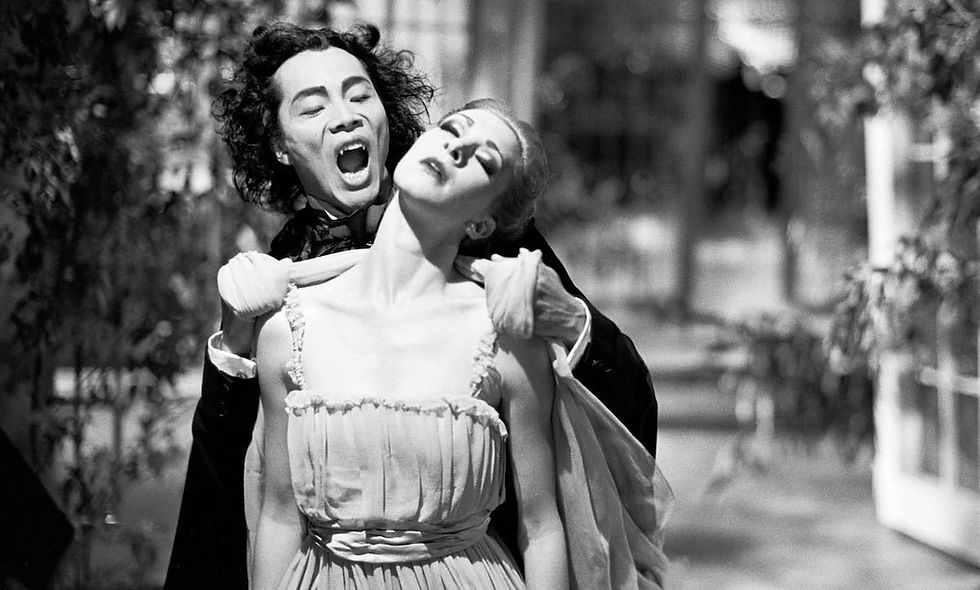
Guy Maddin’s unusual ballet/silent film adaptation foregrounds a more direct acknowledgment of the xenophobia and neuroses of class and sex carved into Dracula’s story structure. Styled as a silent film with intertitles, it makes overt references to cash (and who should have it) and sex (and who you should have it with). Further, with the casting of Chinese performer Zhang Wei-Qiang as Dracula, the xenophobia of the original text takes on more obvious racial meaning: in the opening sequence of the film, blood pours over a map of Europe as the words “IMMIGRANTS!!…OTHERS!…FROM OTHER LANDS…From the East!” flash on the screen. Maddin makes clear the link between the English characters’ dreams and their fear of the other, cutting between Mina’s sleepwalking and Dracula’s face while on his voyage to England. The English dream of the erotic, embodied other is also the nightmare of invasion and replacement, all tied up in blood as lineage and violence. This fusion of fear and desire creates the Dracula figure, and the film’s awareness of these links produces a subversively unsympathetic set of heroes. By the final scene, we are left with Dracula as a martyr or even Christ-like figure, a scapegoat for all the ills of a repressed society, while his killers are painted as base and greedy. If you’ve always scoffed at Jonathan Harker and the “rational,” paternalistic cures of Van Helsing or his equivalent in other adaptations, this one’s for you.
Sally Weitzner is a junior majoring in film and media studies at Columbia GS.