
Pretty in Sepsis: Fake Camp in “Wuthering Heights” (2026)
Review by staff writer Sita Vemuri can be found here.
I. Introduction
The marketing team for “Wuthering Heights” (2026) chose to use quotation marks in the official title of the film—perhaps, inadvertently, referring to Susan Sontag’s 1964 essay, “Notes on Camp,” in which she defined camp as “see[ing] everything in quotation marks” (4). Regardless, whether intentional or not, the choice of quotation marks signaled to the audience that Emerald Fennell intended her adaptation of Emily Brontë’s 1847 book to be seen as camp, or “being-as-playing-as,” Wuthering Heights (Sontag 4). And on that count Fennell delivers: her adaptation presents obsessive, horny, yolky, extravagant, toxic romance.
By exaggerating its aesthetics in “Wuthering Heights,” Fennell mimics the style of camp while inverting its substance. The origins and essence of camp subverts oppression by trivializing the oppressors. On the superficial level, Fennell’s “Wuthering Heights” appears as camp but it lacks the subversive nature, and, instead, reinforces class, gender and racial hierarchies. In other words, the film performs camp without its subversion, its stylization without its resistance, and its exaggerated aesthetics without its rebellion. In fact, the production and box office success of “Wuthering Heights” mark a new stage in camp, its commodification, where the filmmaker takes camp, a weapon of the weak against their oppression, and, instead, turns it into a source of profit from their oppression. While scholars have identified various forms of “camp” such as “gay camp” (Dyer), “feminist camp” (Robertson), and “black camp” (McMillan), this essay argues that the inversion of camp's subversive function in Fennell’s “Wuthering Heights” represents a new form: “fake camp.” The film performs “fake camp” by exaggerating aesthetics, glamorizing wealth, and re-centering whiteness. First, this essay examines the film’s camp aesthetics; then how these aesthetics fail to subvert class, gender and race hierarchies; finally, how casting and narrative choices commodify camp, converting a weapon of the weak into a source of profit for the powerful.
II. The Campiness of Fennell’s “Wuthering Heights”
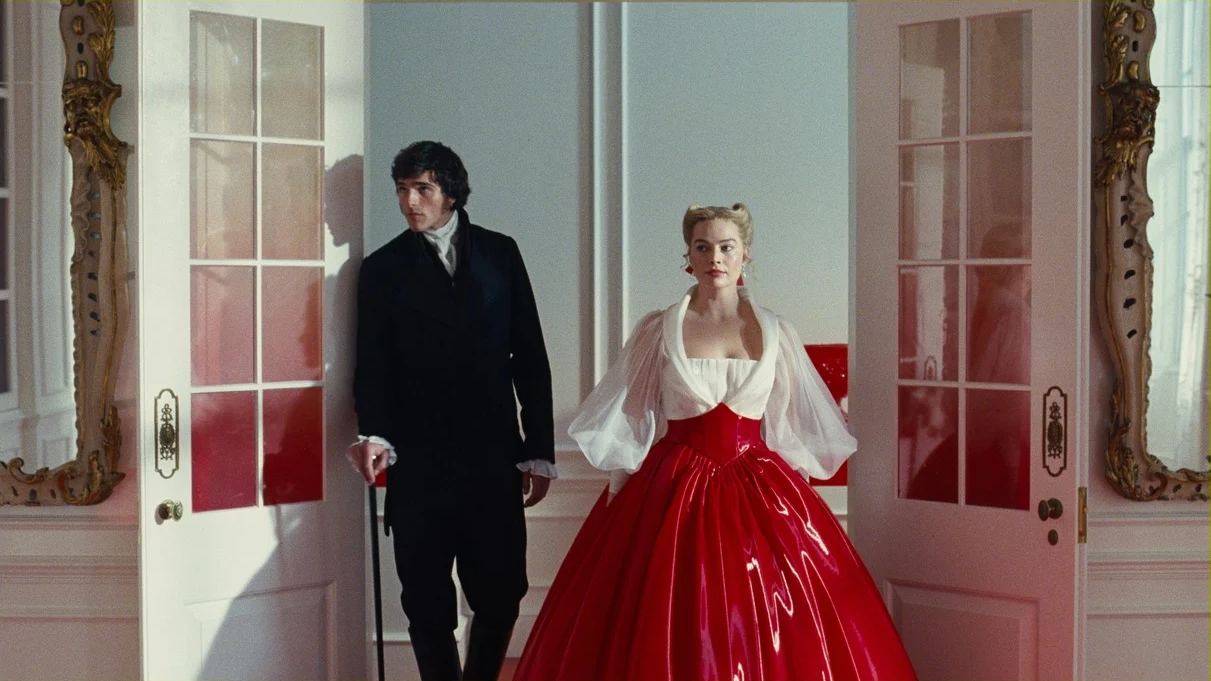
As signaled by its title in quotations, Fennell consciously heightens the camp of “Wuthering Heights.” Camp redefines reality “in terms of style—but a particular kind of style. It is the love of the exaggerated…” (Sontag 3). Fennell’s film definitely loves the exaggerated. Fennell eschews realism for a sensory overload of dreamy palettes, howling winds, and production design so excessive it astonishes and amuses. Catherine’s wardrobe defiantly embraces the ahistoric: candy wrapper wedding dresses, latex Victorian skirts, and veils of redundant tulle paired with jewel-encrusted makeup. Oh, to run in a marvelous dress through the foggy moors. And oh, the hair! The intricate braids of her hair became a TikTok phenomenon, but Fennell’s own nomenclature cemented the braids’ legacy. Fennell called those braids “vagina braids” and later “devil horns” as Catherine grew older (Tangcay). By labeling them “vagina braids” and “devil horns,” Fennell’s film mimics the quintessential elements of camp: the performative self, the over-sexualization of the mundane, and an unapologetic commitment to the “too much” gene.
(Right) This image shows Catherine pressing into the flesh wall that depicts Margot Robbie’s actual skin; that skin decorates Catherine’s room.
However, Fennell’s camp stylizes without the content of subversive intentionality. Richard Dyer was the first to argue that the essence of camp grew out of resistance: “the camp sensibility is very much a product of [white gay men’s] oppression” (59). Dyer argued that gay men use camp as a form of resistance by "prising the form of something away from its content" and "revelling in the style" (52). So camp becomes a political statement for gay men by trivializing their oppression. Robertson expanded that notion to include women by arguing that camp serves as a vital coping mechanism for individuals to "express their discomfort with and alienation from the normative gender and sex roles" imposed by straight culture (271). By utilizing the "masquerade" to simulate femininity, camp exposes the absence of an essential gender identity, revealing it instead as a hollow, socially-constructed performance (Robertson 273). Yet, the theatrical subversion that Robertson claims is not exclusive to gender either. McMillian expanded the definition to include "black performance art," where the body is transformed into an "art object" to reclaim agency (80). But this discourse over which oppressed groups can claim exclusivity over camp only revealed camp to be an expansive and adaptable tool that does not belong to any particular marginalized group; rather, it serves as a tool for any marginalized group (e.g., class, gender, race, sexuality) to resist its oppression, by trivializing oppressive structures through exaggerated theatrics and aesthetics.
In contrast, “Wuthering Heights” uses camp not for subversion but to tell a conventional star-crossed love story of Catherine and Heathcliff. In the context of the film, the camp performance transforms from a survival strategy for the oppressed into a luxury for the privileged, devoid of its subversive content—creating a new form of camp: “fake camp.” On the surface, the camp of “Wuthering Heights” could potentially serve as a critique of capitalism and its class hierarchies since their love is thwarted by their class positions. But, under Fennell’s direction, such a throughline never develops in the film because of the displacement of the villain in the film onto people of color. Rather than a trivialization of the oppressive class structure, Fennell’s fake camp glamorizes wealth and white supremacy, instead.
III. From the Trivialization to the Glorification of Wealth
The film’s opening scene attempts to define Catherine as the villain: Catherine revels in bloodlust during a public lynching of a man. That action subverts audience expectations, redefining the image of Catherine portrayed in the film’s advertising campaigns, turning her from a heroine into a bloodthirsty, class supremacist spectator. Like a sepsis, Catherine’s class supremacy infects her relationship with Heathcliff. She sees him through her lens of her class superiority, framing her relationship with Heathcliff in which she treats him like a "pet," an early foreshadowing that her world is governed by possession rather than affection. Faced with the financial collapse of the Wuthering Heights estate, Catherine chooses the cold stability of a loveless marriage over her soulmate because marrying Heathcliff would “degrade” her class (“Wuthering Heights”). Catherine regrets her decision, so she engages in a forbidden extramarital affair with Heathcliff (of course, only after Heathcliff raises his class position by becoming rich), which eventually leads to her own death. The camp and narrative elements prioritize the raw intensity of the protagonists’ love, framing Catherine’s class supremacist cruelty as a desperate survival mechanism for a love that has no legal or social place to exist—steering audiences away from her villainy and toward her tragedy. As the love affair turns fatal, culminating in Catherine’s death from sepsis, the film portrays her death as a romantic tragedy from her self-destruction for the sake of class.

Fennell’s film presents a half-baked presentation of Catherine’s self-destructive behavior as a class critique. The visual camp elements presented in “Wuthering Heights” undermine that critique by accentuating or exaggerating the aesthetics of wealth. The extravagant gowns, close-ups on oversized strawberries, and the exquisite, gold-encrusted house, due to Catherine’s newfound wealth through marriage (not to Heathcliff), glorify the beauty of an already idealized life of wealth. Thereby, Fennell trains audience members to empathize with Catherine to normalize the idea that anyone would choose wealth over love by creating a narrative that idolizes wealth. The role of camp is to “make us see that what art and the media give us are not the Truth or Reality but fabrications, particular ways of talking about the world, particular understandings and feelings of the way life is” (Dyer 60). Historically, camp has subverted hierarchies, and undermined the status quo, in Fennell’s hands camp reinforces the status quo and idealizes wealth with its aesthetics. The most beautiful parts of the film occur amidst the wealth. The camp elements of candy wrapper dress, the unnaturally large strawberry, running through the foggy moors with latex Victorian skirts, and the jewel-encrusted makeup all idealize wealth without trivializing the class system that it is supposedly critiquing.

IV. The Racialized Villainy of “Wuthering Heights”
While the film’s visual camp elements idealize wealth, the main reason the class critique fails to land through the narrative’s displaced villainy. Catherine is a villain; she kills herself, but Fennell misdirects the audience toward the maid, a woman of color, to blame rather than toward Catherine’s own choices—giving Catherine more grace than she warranted. The two main obstacles to Catherine’s and Heathcliff’s true love are people of color. Nelly is played by the Vietnamese American actress Hong Chau, and Shazad Latif, who is of Pakistani descent, plays Edgar Linton (Catherine’s husband). Catherine marries Edgar Linton because he is a rich landowner; her duty to him stands in the way of true love. But it is Nelly, Catherine’s Asian maid, who Fennell forces into a villain role intentionally to absolve Catherine of her bad choices. It is Nelly who ensures that Heathcliff overhears Catherine saying that marrying Heathcliff would degrade her, causing the lovers to split. It is Nelly who burns Heathcliff’s letters to Catherine. It is Nelly who neglects Catherine, leading to her sepsis poisoning and death. Nelly’s actions create the star-crossed lovers narrative that ends tragically, leading audience members to see the villain not as Catherine but as Nelly. For example, 66.4K people liked an Instagram reel showing Nelly burning the letters, with text reading “good morning to everyone but Nelly,” (@ashleylynn_10). Fennell paints Nelly, a woman of color and maid, as a villain who destroys any possibility of a successful romance between Catherine and Heathcliff.
While the people of color and the “help” serve as the villains of the love story because the film prioritizes the seductive aesthetic of a star-crossed-lovers narrative over its class critique, the casting of villains make it even worse since they ignore the original novel's racial and class tensions. Fennell treats her characters of color as what Robertson calls “camp objects”—figures who are subject to a camp aesthetic but are not permitted to be “camp subjects” with their own agency (Robertson 267). In this framework, Fennell’s film fundamentally misrepresents the restorative power of camp as defined by camp theorists Pamela Robertson, Richard Dyer, and Uri McMillan. Instead of using aesthetics to expose the ugliness of class and colonial history, Fennell’s film uses aesthetics and casting choices to obscure it. For example, by casting Edgar Linton as a South Asian man, the film hides colonial history by portraying him as a rich landowner in the UK, which given his racial identity would have been practically impossible at the time. By casting a white man as Heathcliff and relegating people of color to the roles of villainous "help," the film’s campiness does not empower the marginalized; rather, it uses the exaggerated and the theatrical stylization re-centers whiteness and promotes the privileged. Here, the camp performance is not a survival strategy for the oppressed, but a luxury for the pleasure of the privileged.
V. From Abolitionist Narrative to Re-Centering Whiteness
Fennell’s missteps do not just apply to her actors of color; they also apply to casting a white actor. The film’s reinforcement of white supremacy is clear and direct in that regard, distinguishing the camp in “Wuthering Heights” as a distinctly “fake camp.” Fennell cast white actor Jacob Elordi as Heathcliff, a nonwhite character, an identity key to the story in the original 1847 book. If marginalized people, like the working class, black artists, and gender nonconforming people, have used camp over time as weapon of the weak, then the choice to ignore the inherent dark-skinned nature of the Heathcliff character, a key factor in the original story, undermines the camp in film to substitute it with fake camp. What is remarkable about the substitution of the Heathcliff character with a white actor is that the original 1847 Wuthering Heights was actually written as an abolitionist tale during the height of chattel slavery: “Brontë was using Heathcliff to comment on the Liverpool slave trade” (Zuckerman). The original novel critiqued race and capitalism through the character of Heathcliff, who was oppressed by white supremacy. Converting the film's conflict into an exaggerated portrayal of a conventional star-crossed love story between two white people, undermined by actions of people of color, inverts the central critique of the original novel. And, as a result, rather than critiquing white supremacy, the film uses camp to re-center whiteness and legitimize white supremacy.
VI. The Real Profits of Fake Camp
“Wuthering Heights” encourages a new categorization of camp: fake camp. Fake camp occurs through the co-optation of camp by the privileged. As Richard Dyer says when referring to straight camp, “Something happens to camp when taken over by straights: it loses its cutting edge, its identification with the gay experience…” (60). The same thing could be said about what happens to camp when it is taken over for the privileged. When the privileged use camp, camp loses its meaning or “cutting edge” as a survival strategy for marginalized peoples by trivializing systems of oppression through exaggeration and extravagance. Fake camp occurs when the camp aesthetics lose “its identification” with the marginalized people’s experience of oppression, and instead becomes identified with the entertainment of their oppressors.
The fake camp in “Wuthering Heights” elicited mixed reactions from the box-office audience. Letterboxed user “allain♡” posted “Emily Brontë died of tuberculosis 177 years ago, yet this adaptation is still the worst thing that has ever happened to her,” a post liked by 81,611 other users. But that did not stop“Wuthering Heights” from sweeping the box office with sales of over $50 million with its opening weekend—as well as generating thousands of Jacob Elordi fan-made thirst-trap edits on TikTok based on“Wuthering Heights” (Rubin). In the contemporary social media-driven attention economy, the intense love between Heathcliff and Catherine provoked extreme responses, driving attention—and profits—to the movie, leading Hollywood investors to conclude with certainty that while camp subverts, fake camp sells.
VII. Conclusion
In contrast, if the filmmaker's role goes beyond creating entertainment for the audience and generating profits for investors to one of social commentary and responsibility—to highlight marginal voices and critique power structures—then the fake camp of “Wuthering Heights” serves as a cautionary tale for the future of camp in general. Fennell could have used camp to analyze and critique capitalism, patriarchy, and white supremacy through BDSM, stolen kisses, yolk-poking, fish-fingering, and obsessive love. Instead, she chose to use fake camp to achieve commercial success by emphasizing aesthetics over social function, style over subversive substance, and commodification over moral responsibility. Thus, the emergence of fake camp, represented by “Wuthering Heights” as a profitable enterprise for Hollywood, could, through imitation and replication, threaten and even eradicate true camp. As a result, camp faces a similar fate to that of Catherine at the tragic end of Fennell’s “Wuthering Heights”: filmmakers will commodify the aesthetics, artifice, and style of camp—without its subversion, resistance, and rebellion—to make fake camp appear pretty in sepsis.
Works Cited
@ashleylynn_10. “good morning to everyone but Nelly.” Instagram, 26 Feb. 2026,
allain♡. Review of Wuthering Heights (2026). Letterboxd,
Brontë, Emily. Wuthering Heights. Thomas Cautley Newby, 1847.
Deb, Sopan. “Heathcliff, Jacob Elordi and the Long History of Whitewashing in Hollywood.”
The New York Times, 13 Feb. 2026,
whitewashing.html
Dyer, Richard. "It's Being So Camp As Keeps Us Going." Camp: Queer Aesthetics and the
Performing Subject: A Reader, edited by Fabio Cleto, Edinburgh University Press, 1999, pp. 110-116.
Cosslett, Rhiannon L. "Wuthering Heights Shows How Class and Race Still Shape Who Gets to
Tell Stories." The Guardian, 17 Feb. 2026,
McMillan, Uri. "Nicki-aesthetics: The Camp Performance of Nicki Minaj." Women &
Performance: A Journal of Feminist Theory, vol. 24, no. 1, 2014, pp. 79-87.
Robertson, Pamela. "What Makes the Feminist Camp?" Guilty Pleasures: Feminist Camp from
Mae West to Madonna, Duke University Press, 1996, pp. 3-30.
Rubin, Rebecca. “Wuthering Heights Opens to $38 Million in North America, $83 Million
Globally Over Presidents’ Day Weekend.” Variety, 16 Feb. 2026,
Rubin, Rebecca. “Box Office: ‘Wuthering Heights’ and ‘GOAT’ Hit Major Milestones
Globally.” Variety, 1 Mar. 2026,
Sontag, Susan. "Notes on 'Camp'." Against Interpretation, and Other Essays, Farrar, Straus &
Giroux, 1966, pp. 275-292.
Tangcay, Jazz. "‘Wuthering Heights’ Artisans on Giving Margot Robbie and Jacob Elordi’s
Gothic Romance a ‘Jesus Darcy’ Flare." Variety, 11 Feb. 2026,
Wuthering Heights. Directed by Emerald Fennell, performances by Margot Robbie and Jacob
Elordi, Warner Bros. Pictures, 2026.
Ellison Martin (CC’29) is a filmmaker from Texas and a current Columbia University student majoring in Film & Media Studies. Her documentary Don’t Mess with Texas: An Abortion Story won the Grand Prize at the Tribeca Festival in the RFK Human Rights “Speak Truth to Power” competition and the UIL “Nobelity Social Impact Award.” With over 20 short films and training in directing, cinematography, and screenwriting at UCLA and Yale, Martin’s work blends craft with activism, confronting themes of justice, gender, and identity. Rooted in her background as a youth organizer, she continues to develop new narrative shorts at Columbia that harness cinema to catalyze empathy and social change.