
The Movie that Pulled Off the Greatest Plot Twist in Movie History
When film fanatics and ordinary movie-goers talk about movies with the most unpredictable plot twists, they typically list the following: Memento (2000), Shutter Island (2010), The Usual Suspects (1995), and maybe Fight Club (1999) or even Fall (2022). In a world where ingenious movie endings and unpredictable plot twists are praised and given intense recognition, Primal Fear is criminally underrated and not talked about enough. Directed by Gregory Hoblit, starring Richard Gere and critically acclaimed actor Edward Norton, the film blends courtroom drama with psychological thriller to create an original cinematic masterpiece. What begins as a conventional legal case unravels into a chilling story of manipulation and morality.
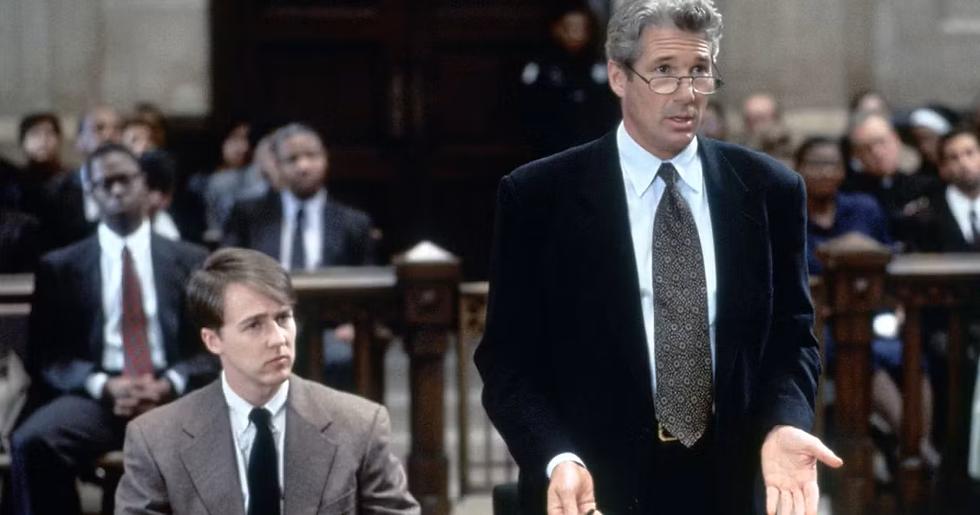
The film stars Martin Vail (Richard Gere), a Chicago defense attorney who is only concerned with gaining publicity, achieving fame, and winning legal cases. When a shy altar boy, Aaron Stampler (Edward Norton), is accused of gruesomely murdering a powerful archbishop, Vail takes on the case pro bono, convinced this highly publicized case will boost his reputation. Aaron, at first glance, seems completely incapable of murder: he stutters, avoids eye contact, and speaks with a nervous childlike sincerity. His frail posture and constantly trembling hands make him appear more like a frightened victim than a killer. His demeanor—polite, timid, and fearful— invited both Vail and the audience to see him as gentle and harmless. Vail and the audience are left questioning how this shy boy could commit such a gruesome crime.
Primal Fear stands out from all other legal dramas because of its intricate blend of genres and themes—it’s simultaneously a courtroom thriller, a psychological study, and an exposé on institutional corruption. Viewers get both fiery, intense scenes inside the courtroom but also deep, psychological interrogations outside of the courtroom. We also get snippets of investigations that Vail conducts to try and uncover the truth; Vail follows leads, interviews witnesses, and pieces together the political and religious motives that culminated in the murder. These scenes heighten the suspense of the film and give the audience a rare glimpse into how truth and deception are deeply intertwined outside the courtroom’s controlled environment, setting the film apart from standard legal dramas that focus solely on trial scenes. Lastly, Primal Fear also brings in the complex inner workings of the Catholic church—specifically the corruption, bribery, and abuse that have been hidden from the public. This film attacks intense themes of murder, sexual abuse, and psychological disorders, but is able to perfectly weave them together to create a riveting movie-watching experience.

Another reason this film needs more recognition is the fact that it was pivotal in jump-starting Ed Norton’s acting career. He does a phenomenal job in this film—in my opinion, the best acting he has ever done—because he is able to portray an incredibly complex character: an altar boy who fakes having a dissociative identity disorder (also known as split personality or multiple personality disorder) to manipulate the legal system. Norton’s character is remarkably layered; he must embody both the timid altar boy Aaron Stampler and his violent alter ego Roy, while ultimately revealing himself to be a manipulative, traumatized boy who wants to escape conviction.
As the trial unfolds, Primal Fear seems to be building toward a familiar courtroom climax: a defense attorney fighting to prove that his client’s violent outbursts are caused by a genuine mental disorder. But just when both Vail and the audience are completely convinced of Aaron’s innocence, the film delivers a perfectly crafted, climactic twist—Aaron fabricated his split personality disorder and that his alter ego, Roy, never existed—reframes the entire narrative. What initially appears to be a film about the intersection of justice and mental illness shifts into a film polluted with deception and moral blindness. This revelation functions on multiple levels. We see the manipulative genius of Stampler as he is able to fake his psychological disorder so realistically that he fools not just the main character, but the audience as well. We also witness how this twist undermines Vail’s egotistical belief in his own moral superiority: while Vail thought he was helping bring justice to an innocent boy by fighting for a not guilty verdict by reason of mental disease or defect, he is forced to reflect on who he has become when he figures out that he let a guilty man walk free. We also see how the film marvelously makes us viewers question our willingness to believe appearances and performances.

Despite its brilliance, Primal Fear is rarely included in discussions surrounding cinema’s greatest unpredictable endings. Maybe it’s because the film disguises itself as just an ordinary courtroom drama and doesn’t advertise the various elements—the psychological tension, moral corruption within the Church, or the intricate legal strategizing that drives the story. Perhaps it’s because Norton’s breakout role in this movie was overshadowed by later successes like Fight Club and American History X (both of which are “must-watches” in my opinion), but in truth, very few films can masterfully blend character study, performance, plot deception, and acting. Primal Fear is not only a movie with an insane plot twist—it expresses a revelation about the true nature of manipulation, both on screen and off. This film leaves the audience feeling uneasy, not just because of what they have witnessed, but because of how easily we, too, fell for the same lies that Vail did. In the end, Primal Fear is far beyond a courtroom thriller with a twist—it’s a haunting reminder of how the truth can be performed, justice can be manipulated, and even the audience can become the ultimate victim of deception.
Nicole Au is a freshman at Columbia University studying Psychology and Film. When not sharing her love of film, she likes to bake, paint, find new food spots in the city, or do jigsaw puzzles. While a cinephile, she especially loves all movies starring Tom Hanks.